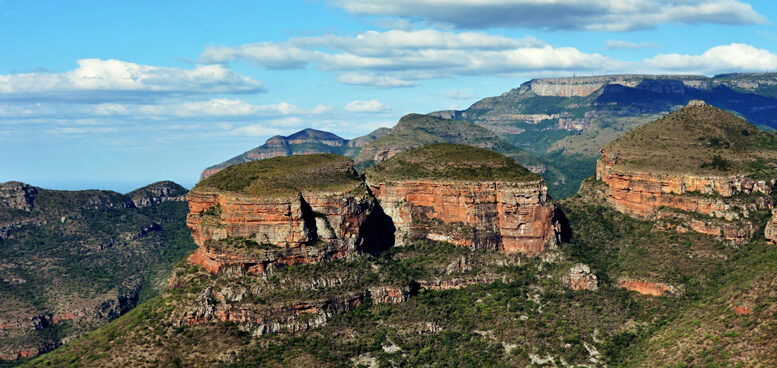
The drive from Johannesburg to Kruger National Park is not just a transfer — it is, for many travellers, one of the most scenically dramatic overland journeys in South Africa. The route east through Mpumalanga takes you through four distinct landscapes in a single morning: the flat, dry highveld of Gauteng, the rising terrain of the Drakensberg Escarpment, the vertiginous viewpoints of the Panorama Route, and the drop into the warm, wildlife-rich lowveld where Kruger National Park begins. Knowing what you are driving through — and choosing to stop — transforms a five-hour transfer into a genuine destination experience.
This guide covers everything you need to know about the Panorama Route: what it is, where the key stops are, how it connects to your Kruger safari, and how to structure a trip that does justice to both the landscapes and the wildlife.
What Is the Panorama Route?
The Panorama Route is a scenic drive along the edge of the Mpumalanga Escarpment — the dramatic geological boundary where the South African highveld drops steeply away into the lowveld below. The escarpment here plunges more than 1,000 metres in places, creating the canyon systems, waterfalls, viewpoints, and cliff-edge vistas that have made this one of South Africa’s most visited scenic drives.
The route runs roughly from the town of Graskop in the south to the Blyde River Canyon Nature Reserve in the north — a stretch of about 60 kilometres that concentrates more dramatic scenery per kilometre than almost anywhere else in the country. The key viewpoints and geological formations are all within easy reach of each other, making the Panorama Route a day excursion that rewards a relaxed pace and clear weather.
For Kruger safari travellers, the Panorama Route sits almost exactly on the line between Johannesburg and Hazyview — meaning you can incorporate the highlights into your transfer day without significantly adding to your overall journey time. Our 4-Day Kruger Safari & Panorama Route from Johannesburg is built specifically around this combination, giving you a dedicated full-day Panorama excursion as part of the itinerary.
The Key Stops on the Panorama Route
Blyde River Canyon
The Blyde River Canyon is the centrepiece of the Panorama Route and one of the most significant geological features in Africa. At roughly 26 kilometres long and 800 metres deep, it is the third-largest canyon in the world — and unlike the arid rock formations of the Karoo or the American Southwest, Blyde is green. The canyon walls are lush with subtropical vegetation, the river runs along the canyon floor, and the Three Rondavels — three enormous rounded dolomite peaks rising from the canyon’s southern end — are among the most photographed natural features in South Africa.
The viewpoints along the canyon rim give you perspectives at different distances and angles. The main viewpoint at Bourke’s Luck looks directly across to the Three Rondavels. Further north, the canyon narrows and the river becomes more visible below. Arrive early for the clearest light and the most dramatic photographs.
God’s Window
God’s Window is a viewpoint cut into the escarpment edge above Graskop where the highveld drops suddenly and completely away. The name requires no explanation when you are standing at the railing looking out: the land falls a thousand metres in front of you and the lowveld stretches to the horizon — flat, green, and vast, with the air above it shimmering in the heat. On a clear day you can see the escarpment’s shadow stretching east toward Mozambique.
The walk to the viewpoint from the car park passes through cloud forest — an extraordinary microclimate of mossy tree ferns, ancient Outeniqua yellowwoods, and giant cycads that exists because the escarpment edge captures moisture from the rising lowveld air. This 15-minute walk is, for many visitors, as memorable as the view itself.
For anyone planning to photograph these landscapes, our Photography Settings for Game Drives: A Greater Kruger Cheat Sheet includes escarpment and landscape settings alongside the in-park game drive advice.
Bourke’s Luck Potholes
Where the Treur River meets the Blyde River, millennia of swirling floodwater have carved cylindrical potholes into the yellow and red dolomite rock at the confluence. The colours — rust, ochre, gold, and black — and the geometric perfection of the carved chambers create a landscape that looks engineered rather than natural. The viewing bridges above the potholes and river confluence give you several angles on the formation, and the interpretive centre explains the geological processes that created them.
Bourke’s Luck tends to be busiest around midday. An early morning or late afternoon visit gives you better light for photography and fewer visitors on the bridges.
The Three Rondavels
The Three Rondavels are the three domed peaks that rise from the southern end of the Blyde River Canyon — named for their resemblance to the traditional rounded clay huts of the Sotho people. The viewpoint here is one of the most iconic in South Africa, looking directly across the canyon to the three peaks with the river visible far below and the canyon walls stretching away in both directions. This is the photograph most associated with the Panorama Route and one of the strongest arguments for making the escarpment a deliberate stop on your Kruger safari transfer rather than bypassing it on the N4.
Lisbon and Berlin Falls
Two significant waterfalls along the Panorama Route — Lisbon Falls (the highest in Mpumalanga at 92 metres) and Berlin Falls (a narrower plunge waterfall with a natural pool at its base) — offer short walking stops between the major viewpoints. The falls are at their most dramatic during and immediately after the summer rainy season (October to March), when the escarpment streams are full.
Panorama Route as a Kruger Safari Transfer: How It Works
The practical geography of the Panorama Route makes it a natural extension of any Johannesburg to Kruger transfer. The route from Johannesburg heads east on the N12 or N4 toward Nelspruit, then branches north toward Graskop and the escarpment before descending to Hazyview and the park gates. This routing adds approximately two to three hours to the transfer time depending on how many stops you make — a reasonable exchange for the quality of what you see.
Our Kruger Safaris from Hazyview page covers the full range of game drive options from Hazyview, which sits at the base of the escarpment just 14 kilometres from Phabeni Gate. When sourcing the right Accommodation in Hazyview, travelers who include the Panorama Route on their transfer day typically arrive at their lodge in the early afternoon.
For travellers staying at Tembo Guest Lodge in Hazyview, the Panorama Route is also available as a standalone day excursion during your stay — making it easy to do a full morning game drive, return to the lodge for lunch, and spend the afternoon on the escarpment without losing a single game drive session.
Best Time to Drive the Panorama Route
The Panorama Route is accessible year-round, but the experience changes significantly with the seasons.
April to September (dry season) brings clear skies, excellent visibility from the viewpoints, and the golden-brown lowveld landscape stretching out below the escarpment. This is the best time for photography at God’s Window and the Blyde River Canyon viewpoints.
October to March (wet season) brings lush green vegetation on the escarpment, full waterfalls, and the dramatic cloud formations that give God’s Window its most atmospheric conditions — though mist can occasionally obscure the views entirely.
The route’s scenic quality makes it worth visiting in any season. For a broader guide to timing your Mpumalanga trip, our Peak vs Shoulder Season in Greater Kruger: Crowds, Prices, and Sightings post covers the full calendar and how each season affects both the escarpment and the park.
Combining the Panorama Route with a Kruger Safari
The combination of the Panorama Route and Kruger safari is one of the most complete South Africa experiences available from Johannesburg. In four or five days you cover the full spectrum of what Mpumalanga offers: the geological drama of the escarpment, the vast flat wilderness of the national park, and the wildlife encounters that bring people back to this region year after year.
Our tour options for combining both experiences:
- 4-Day Kruger Safari & Panorama Route from Johannesburg — the dedicated combination itinerary, with a full Panorama day built into the schedule
- 5-Day Private Kruger Safari from Johannesburg — five days of Kruger game drives with the Panorama Route available as an add-on
- Kruger Safaris from Hazyview — day and half-day game drives from Hazyview, ideal for travellers who self-drive the Panorama Route and want guided wildlife experiences in the park
The escarpment and the park are at their best when treated as partners rather than alternatives. The landscapes of the Panorama Route give you the scale of this part of Africa — the sheer vastness of the lowveld below the canyon. The game drives in Kruger then bring that landscape alive at ground level. Together, they deliver the full Mpumalanga experience.
Planning your trip? Visit our Kruger National Park page for the complete range of safari packages from Johannesburg, Hazyview, and Cape Town.