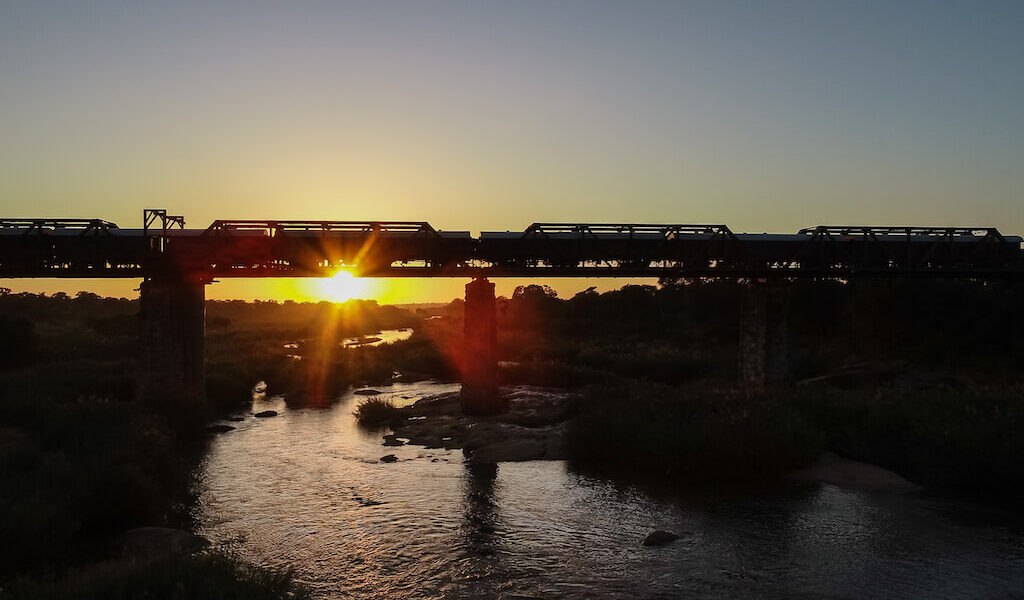
There is a lodge in Kruger National Park that sits suspended above the Sabie River on a historic railway bridge, where vintage train carriages serve as your suite, the river flows beneath your bed, and hippos surface in the water below your window before dawn. This is Kruger Shalati — Train on the Bridge, and it is one of the most genuinely extraordinary safari accommodation concepts anywhere in Africa. Not extraordinary in the generic hospitality marketing sense, but architecturally, historically, and experientially unlike anything else that exists within a national park.
This post explains what the Kruger Shalati experience actually is, how it works, what staying there feels like on a real game-drive day, and why the fly-in format makes it the most time-efficient luxury Kruger safari available from Johannesburg or Cape Town. If you have been looking at our 3-Night Fly-In Kruger Shalati Safari and wondering whether it lives up to the concept, this is the deep read you need.
The History Behind the Bridge
The Shalati bridge at Skukuza is not a prop. It is a real piece of South African railway history — the Selati Line bridge, built in the early 1900s as part of the rail connection between Mozambique and the goldfields of the Witwatersrand. For decades, the same bridge that now holds your suite carried steam locomotives loaded with gold ore through what would later become Kruger National Park.
The line was eventually decommissioned and the tracks removed, but the bridge remained — a century-old iron structure spanning the Sabie River at one of its most wildlife-productive points, just east of Skukuza Rest Camp. For years it stood unused while the game below it went entirely undisturbed: elephant crossing the shallows, crocodile holding the midstream rocks, leopard moving along the banks at night.
When the Kruger Shalati concept was developed, it used the bridge itself as the foundation — bolting the lodge structure onto the existing ironwork and suspending rooms over the river in converted vintage train carriages. The result is accommodation that is simultaneously heritage, architecture, and conservation — built without disturbing the riverbank, causing no ground-level footprint, and positioning guests directly above one of Kruger’s most active wildlife corridors.
Understanding this history changes how you experience the lodge. You are not just in an unusual hotel. You are in a specific place with a specific story, watching the same river that railway workers, early conservationists, and generations of wildlife have used for over a century.
What the Lodge Actually Looks Like
Kruger Shalati consists of two components: the train carriages on the bridge itself, and the Glass House — a contemporary glass-and-steel structure cantilevered over the riverbank adjacent to the bridge.
The train carriages are restored and redesigned vintage railcars, each transformed into a luxury suite with full en-suite bathroom, air conditioning, a private deck, and floor-to-ceiling windows overlooking the Sabie River below. The carriages are intimate — not large by conventional lodge standards — but the spatial experience is extraordinary. You wake up with the river flowing beneath you. The sound is constant. The wildlife is immediate.
The Glass House is the lodge’s central social space — a dramatic open-plan structure of glass walls and a cantilevered deck that extends over the river. This is where meals are served, sundowners are held, and where guests gather between game drives to watch the river activity below. Buffalo drink from the banks. Elephant wade through the shallows. The Glass House is designed around the view in a way that makes passive wildlife watching as rewarding as the drives themselves.
The overall atmosphere is one of deliberate restraint. Kruger Shalati has resisted the temptation to over-programme or over-design. The bridge, the river, and the bush are the experience. The lodge simply positions you within them.
Why Fly In? The Skukuza Airport Advantage
Our Kruger Shalati package is a fly-in safari, and the reason for that is straightforward: Skukuza Airport sits inside Kruger National Park, within a few kilometres of the lodge. Flying in from Johannesburg or Cape Town eliminates the five-hour overland transfer entirely and deposits you inside the park — at one of its best wildlife areas — within an hour of your departure.
The overland transfer from Johannesburg to Skukuza is not unpleasant, but it costs half a day in each direction on a three-night stay. When you fly, you arrive in time for an afternoon game drive on day one and you leave after a morning game drive on your final day — adding an entire extra drive session compared to the road option. On a short luxury stay, that is significant.
Skukuza is Kruger’s largest rest camp and its operational centre, positioned in the southern section of the park where wildlife density is highest. Landing there means your first view of Kruger is from the air — the Sabie River winding through the bushveld, However, if flying directly into the park doesn’t fit your budget, starting your journey from a local Hazyview Guesthouse and driving in via Phabeni Gate offers an equally scenic and accessible entry option
For travellers combining Kruger with Cape Town, the fly-in model makes the logistics of a South Africa itinerary clean: Cape Town for the coast and winelands, flight to Skukuza for the wildlife chapter, return to Johannesburg. Our Kruger Safari from Cape Town page covers how this connection works in practice.
The Game Drives: What Southern Kruger Delivers
Skukuza sits in the heart of southern Kruger — the section of the park between the Crocodile River and the Sabie River, which is widely regarded as the park’s most wildlife-productive terrain. The combination of riverine forest along the Sabie, open plains, and mopane woodland creates habitat diversity that supports the full range of Kruger’s species at high densities.
Lion are common across the southern zone. Multiple resident prides work the Sabie River corridor and the plains around Lower Sabie and Skukuza, and your guide knows their current ranges and movement patterns. Three-night stays regularly deliver multiple lion sightings across different sessions.
Leopard in southern Kruger are Kruger’s most reliably encountered leopards — partially habituated to vehicles in the areas closest to Skukuza, and frequently active in the dense riverine vegetation along the Sabie. The combination of good leopard density and excellent guiding makes a close leopard sighting a realistic expectation rather than a lucky exception.
Elephant are abundant — the southern Sabie River corridor hosts some of the park’s largest breeding herds, and close-range encounters with these herds at waterholes and river crossings are a near-daily feature of game drives in this area.
White rhino, buffalo, hippo, crocodile, giraffe, zebra, and wildebeest all feature regularly, along with exceptional birdlife along the river — African fish eagle, saddle-billed stork, giant kingfisher, and a full range of the park’s 500-plus species.
The bridge’s position over the Sabie River also means that wildlife viewing from the lodge itself is substantive. Guests regularly watch elephant from the Glass House deck, spot crocodile from their carriage windows, and hear lion calling from the opposite bank in the evening. This passive, lodge-based wildlife experience is one of the things that sets Kruger Shalati apart from any other Kruger accommodation.
For a detailed guide to what you are likely to see and how to read the animals you encounter, our Big Five Behavior Guide: How to Spot and Photograph Iconic Wildlife in Kruger is worth reading before your first drive.
A Typical Day at Kruger Shalati
Before dawn: The Sabie River is at its most active in the hour before sunrise. Hippos return to the water from their overnight grazing. A crocodile slides off the bank below your carriage. The bird chorus begins — francolin calling from the bush, fish eagle from the opposite bank.
05:30: Morning game drive departs. The guide has already been in contact with the Skukuza ranger network about overnight sightings — where the lion pride was seen at 03:00, which waterhole the elephant herd used at dawn. The drive heads for the most productive current areas.
09:00: Return to the Glass House for a full bush breakfast with the river below and the morning light angling across the water.
Midday: The lodge and the river. Read on the deck. Watch a buffalo herd drink from the far bank. Sleep to the sound of the current below your carriage.
15:30: Afternoon game drive departs. This is the golden-hour session — the light that makes every sighting look like a photograph, and the hour when predators begin to move. The drive runs until after dark.
19:30: Sundowners, dinner in the Glass House, and the African night settling over the river and the bridge that has stood above it for over a hundred years.
Who Is Kruger Shalati For?
Kruger Shalati works for a specific traveller — someone who wants a luxury safari experience that is genuinely distinctive rather than generically high-end, who values design and history as much as service and thread count, and who wants to feel the park rather than just visit it. The bridge positioning, the river sound, and the intimacy of the carriage suites create an experiential depth that larger lodge formats cannot replicate.
It is an outstanding choice for couples and honeymooners — the intimacy of the carriage suites and the river setting make it one of the most romantic safari destinations in South Africa. Our post on Honeymoon in Greater Kruger: Romantic Bush Dinners, Star Beds, and Spa Time covers the broader context of romantic safari experiences in this region.
It also suits serious travellers combining South Africa’s highlights — Cape Town, the Winelands, and Kruger — who want the wildlife chapter to be as architecturally interesting as the rest of their trip.
Practical Details
The Kruger Shalati fly-in package departs from Johannesburg and includes the scheduled flight to Skukuza, three nights in a train carriage suite, all meals, guided game drives, and return flights to Johannesburg. The minimum stay is three nights, which delivers the right amount of time to experience the lodge properly: the first drive to orient yourself, two full days of game viewing, and the final morning to absorb what you are leaving.
For timing, the dry season (May to September) produces the most consistent game viewing and clear skies for the flight in. The shoulder months of April and October balance good sightings with lighter lodge occupancy. A full seasonal breakdown is available in our Peak vs Shoulder Season in Greater Kruger: Crowds, Prices, and Sightings guide.
Is There Anything Else Like It?
In Kruger National Park, no. In Africa broadly, the combination of heritage structure, suspended position over an active wildlife river, and national park game viewing has no direct equivalent. There are other genuinely extraordinary lodges — and we cover many of them on our Greater Kruger page — but Kruger Shalati is in a category of one.
If you have been waiting for the right reason to do a fly-in Kruger safari, this is it.