If you are new to safari, it is easy to assume the person driving the vehicle does everything. Then you arrive in Greater Kruger, climb into an open safari vehicle, and notice two professionals up front: one behind the wheel and another on the tracker seat over the hood. That is when the question comes up fast.
Who does what?
On many Greater Kruger game drives, the ranger, often called the field guide, leads the guest experience. The tracker focuses on finding wildlife, reading signs, and helping the team work safely around animals. They are distinct roles, and when both are on the vehicle, they can turn a good drive into a sharply tuned wildlife experience.
Why safari job titles can be confusing in South Africa
Part of the confusion comes from language. Guests often use the word “ranger” for the person hosting the drive. In daily safari conversation, that usually means the guest-facing guide. In South African guiding circles, “field guide” and “safari guide” are often more precise terms for that role.
At the same time, “game ranger” can also refer to a different kind of conservation professional working behind the scenes on reserve management, habitat work, game counts, anti-poaching support, infrastructure, or assisting wildlife veterinarians. Those professionals may not be the people taking guests out each morning and evening.
So when a lodge says your safari includes “rangers and trackers,” it is usually talking about the on-vehicle guide and the tracker, not a reserve management team member joining your sunset drive.
What the safari ranger or field guide does on a Greater Kruger game drive
The ranger or field guide is the main host on the vehicle. This person welcomes guests, explains the plan for the drive, manages timing, answers questions, and interprets what you are seeing in a way that makes the bush feel alive rather than random. A lion sighting is exciting. A guide who can explain pride structure, territorial behavior, and the reason the lions chose that drainage line makes it much richer.
The ranger is also responsible for the flow of the drive. That includes choosing routes, reading weather and light, balancing guest interests, and deciding when to stay at a sighting or move on. Good guides are constantly weighing options. Should the vehicle linger with a leopard in a marula tree, or head to the river before elephant movement picks up? That judgment shapes the day.
Safety sits with the guide too. On a vehicle-based safari, that means positioning the vehicle properly, reading animal behavior, keeping guests calm, and making clear decisions around distance and timing. If the lodge offers walks, a separate walking qualification is usually required for the person leading guests on foot.
A field guide’s work often includes:
- Hosting: guest comfort, pace, and communication
- Interpretation: wildlife behavior, birds, trees, tracks, ecology
- Safety: vehicle positioning, animal distance, guest briefings
- Planning: route choice, light conditions, radio use, timing
What the safari tracker does on a Greater Kruger game drive
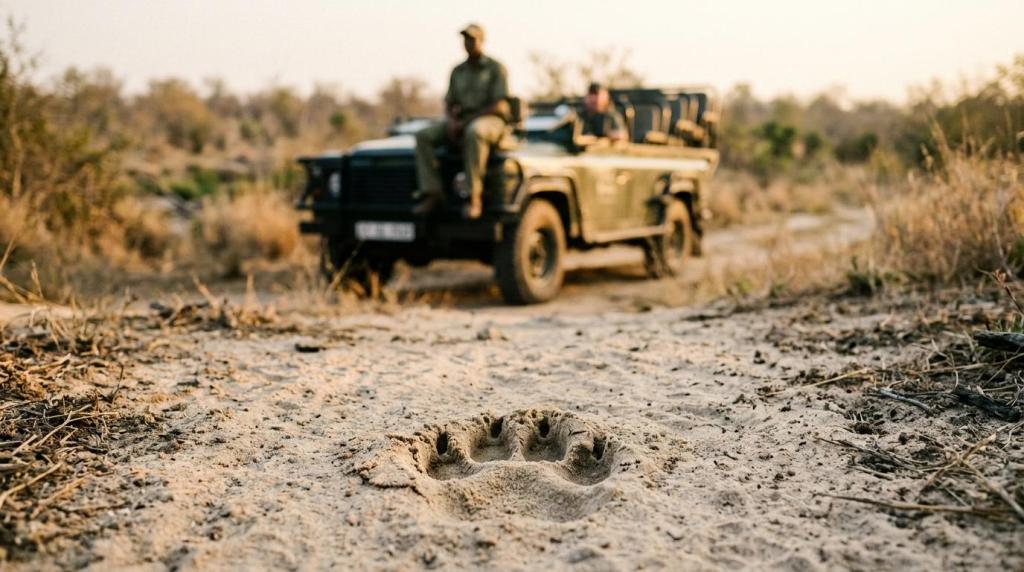
The tracker’s role is more specialized, and to many first-time visitors, more mysterious. A skilled tracker reads the bush like a living map. Spoor in sand, bent grass, alarm calls, scent, fresh dung, a snapped twig, disturbed dust on a road, all of it can point to where an animal moved, how long ago, and what it may do next.
In many Greater Kruger private reserves, the tracker rides on the tracker seat mounted at the front of the vehicle. From there, visibility is better, especially when scanning the road for spoor early in the morning. That seat is not there for style. It is a working position designed for wildlife detection.
Trackers also contribute heavily to safety. In many operations, they are central to assessing what is happening around the vehicle and helping the team approach wildlife in a calm, controlled way. They may speak less than the guide during the drive, but their input can be decisive when animals are moving through thick bush or when a fresh trail needs careful handling.
A tracker may pick up clues like these:
- Fresh spoor on a sandy road
- Alarm calls from impala or francolin
- New scuff marks near a waterhole
- Vultures dropping lower over one patch of bush
- Drag marks leading off a two-track road
Safari ranger vs tracker comparison on a Greater Kruger game drive
The easiest way to separate the roles is to look at their primary focus.
| Role | Main focus | Guest interaction | Key skills | Typical position | During a sighting |
|---|---|---|---|---|---|
| Ranger / Field Guide | Hosting and interpretation | High | Wildlife knowledge, communication, safety, driving, route planning | Driver’s seat | Explains behavior, manages vehicle placement, answers questions |
| Tracker | Finding and following wildlife | Lower, though it varies by person and lodge | Tracking, reading spoor, animal movement, bush awareness, safety support | Front tracker seat | Spots signs, helps locate animals, reads movement in dense bush |
| Trails Guide | Leading guests on foot | High | Walking safety, firearm competency, bushcraft, dangerous game procedures | On foot | Conducts guided walks rather than standard drive hosting |
This is why a drive with both professionals can feel so sharp. One person is focused on your experience and the bigger ecological picture. The other is intensely tuned to the signs animals leave behind.
How ranger and tracker teamwork improves Big Five sightings
When people talk about the magic of a Greater Kruger safari, they are often describing teamwork without realizing it.
Imagine an early morning drive. The tracker notices fresh lion spoor crossing the road, with edges still crisp from the night’s cool air. The guide stops, checks direction, listens, and asks everyone to stay quiet. The tracker studies the pattern and indicates that the lions were moving toward thicker cover near a drainage line. The guide follows carefully, keeps the vehicle positioned into the wind where possible, and explains what is happening without breaking the moment.
A few minutes later, the tracker picks up alarm calls from impala. The guide slows again. Then the pride appears, first as movement in grass, then as full shapes in the open.
That is not luck alone. It is a mix of detection, interpretation, patience, and bush sense.
As Crop IQ Tech points out in its guide to building monitoring programs, combining multiple cues over time and agreeing thresholds before you act is what turns raw signs into reliable decisions.
The guide makes the sighting meaningful for guests. The tracker helps make the sighting happen in the first place.
Safari guide qualifications and walking guide qualifications in South Africa
Another useful distinction is between vehicle-based guiding and walking guiding. They are related, but they are not the same qualification path.
The Certified Field Guide designation is widely recognized as the starting point for professional vehicle-based safari guides. This is the qualification track most closely tied to the guest-facing role people meet on game drives. It covers the core knowledge and practical standards needed to guide from a vehicle.
Walking safaris sit in a different category. Certified Trails Guides are trained for work on foot, including firearm competency, safe approaches to dangerous game, and bushcraft skills like basic tracking and navigation. Above that level, Certified Professional Trails Guides can lead extended or multi-day walking safaris and mentor other trails guides.
That separation matters because guests sometimes assume a great vehicle guide automatically leads walks, or that a brilliant tracker automatically holds walking guide credentials. Sometimes that overlap exists. Sometimes it does not. On a well-run safari, roles and qualifications are matched to the activity.
Are all Greater Kruger safaris led by both a ranger and a tracker?
No, and that is worth knowing before you book.
Many private reserve lodges in Greater Kruger package the two roles together because the combination works especially well for predator tracking, off-road approaches where permitted, and those low-light morning and evening drives when signs in the bush matter most. At the same time, not every lodge or every vehicle will have a dedicated tracker. Some safaris are guide-led only, and many of those are still excellent.
If having both roles matters to you, ask before confirming. A few practical questions can clear it up quickly:
- Dedicated tracker: ask whether every game drive includes one, or only some vehicles and some departures
- Walking safaris: ask if bush walks are included and whether they are led by qualified trails guides
- Vehicle size: ask how many guests share the vehicle on each drive
- Drive schedule: ask whether sunrise drives and afternoon or evening drives are standard
What this means when choosing a Greater Kruger safari
If your goal is a classic private-reserve experience with stronger wildlife detection, richer interpretation, and a more immersive rhythm to the day, a lodge that uses both professional guides and trackers is often a strong fit. This can be especially appealing for first-time safari travelers, photographers, honeymooners, and families who want the confidence of being looked after while still feeling close to the wild.
This setup is also one reason private reserve safaris feel different from self-drive trips. The wildlife is not “better” because of the vehicle. The difference is in how the safari is conducted. Skilled guides and trackers can read the bush in ways that most visitors simply cannot, especially around predators, nocturnal sightings, and subtle animal behavior.
You can see this reflected in actual Greater Kruger lodge packages. One Thornybush itinerary, for example, includes four open-vehicle game drives, scheduled as sunrise and sunset outings, and describes the experience as being led by professional rangers and trackers. That kind of pairing tells you a lot about the style of safari on offer.
When you know the difference between the ranger and the tracker, you book with clearer expectations. You also start to notice more once you are out there: why the vehicle stops for a faint print in the dust, why everyone falls quiet when impala begin staring into one patch of bush, and why the best sightings often begin long before the animal comes into view.