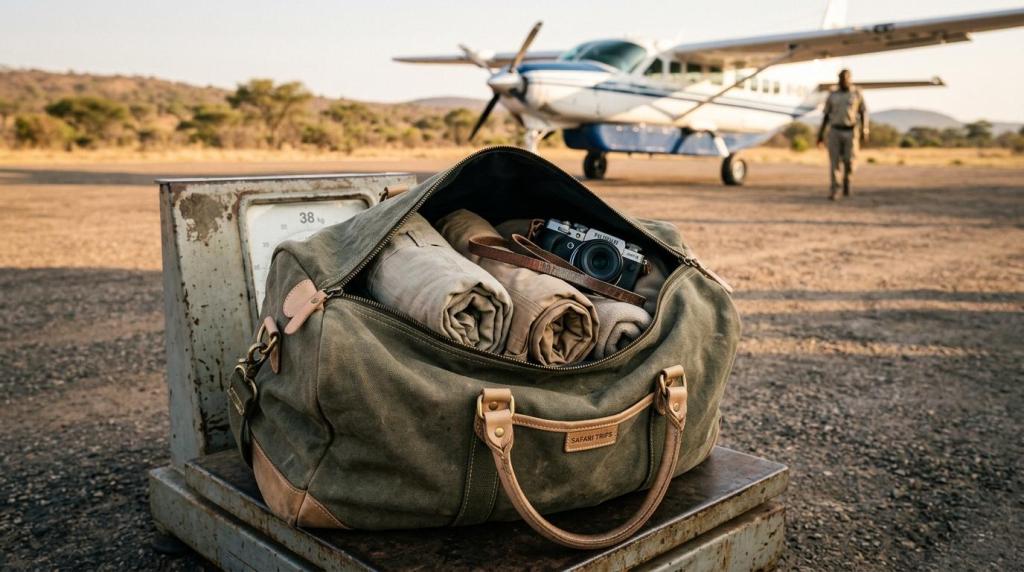
A fly-in safari can make Greater Kruger feel surprisingly close. You leave a major city, land near the reserve, and within hours you can be on a game drive watching elephants cross a dry riverbed or lions settle into the shade.
That speed is real, but it only feels easy when the logistics are handled well. The most common trouble spots are simple ones: choosing the right airport, allowing enough time for lodge transfers, packing for small-aircraft luggage limits, and arriving at check-in early enough that the day stays calm.
Greater Kruger entry airports for fly-in safaris
Most fly-in itineraries into Greater Kruger start with one of three airports: Hoedspruit Airport, Skukuza Airport, or Kruger Mpumalanga International Airport. SANParks also lists Phalaborwa as an access point to the wider Kruger area, though for many private reserve stays it is less commonly used than the first three.
Which airport makes the most sense depends on where you are staying. A safari in a private reserve may still involve a road transfer after landing, even if the flight itself is short. That is why the “best” airport is not always the closest one on a map. It is the one that fits your lodge location, flight schedule, and transfer timing.
| Airport | Best fit for | What to expect after landing |
|---|---|---|
| Hoedspruit Airport | Many Greater Kruger private reserves and lodges | Usually a pre-arranged road transfer to the lodge or reserve gate |
| Skukuza Airport | Stays inside Kruger or properties with easier Skukuza access | Often the shortest onward road leg for some Kruger-area stays |
| Kruger Mpumalanga International Airport | Travelers needing broader flight choices or specific schedule connections | A longer road transfer is common |
| Phalaborwa Airport | Select northern Kruger itineraries | Best for specific routing rather than broad Greater Kruger access |
Flight patterns do change by season and airline schedule, so it helps to confirm current routings before locking in a lodge. SANParks notes daily flights from Johannesburg to Skukuza, Phalaborwa, Hoedspruit, and Kruger Mpumalanga International Airport, and daily flights from Cape Town to Skukuza as well.
Greater Kruger lodge transfers after your flight
The phrase “fly-in safari” can be slightly misleading because the flight is only one part of the trip. After landing, most travelers still have a lodge transfer ahead of them. That may be a short scheduled shuttle, a private road transfer, or a lodge pickup arranged to match your arrival time.
This matters because a fast flight can still become a long travel day if the onward transfer is not timed properly. Baggage collection, meeting a driver, and driving into the reserve all take time. In some cases, a traveler who lands late in the afternoon may miss the lodge’s regular game-drive schedule on arrival day.
A few planning habits make this much smoother:
- Match the airport to the lodge: the nearest airport is often the simplest option, but not always the best if the schedule creates a poor arrival time.
- Build in buffer time: allow for check-in, delays, baggage collection, and the road leg to camp.
- Pre-arranged lodge pickup
- Shared shuttle transfer
- Private road transfer
- Light-aircraft hop to a private airstrip
If your safari includes a very small charter flight into a private reserve airstrip, the transfer becomes even more time-sensitive. Those flights often work on tight daily rotations, and luggage restrictions are usually stricter than on standard domestic airline sectors.
Airstrips and private reserve access in Greater Kruger
Many travelers picture a single airport arrival followed by a game drive, but Greater Kruger can also involve smaller airstrips closer to private lodges. This is where logistics become more specific.
Private reserve airstrips can save time on the road and get you closer to camp quickly. They are especially appealing for high-end fly-in itineraries or for guests trying to fit a safari into a shorter South Africa trip. The trade-off is that small aircraft have much less cargo space, and operations are more tightly tied to weather, daylight, and payload limits.
That is why soft bags matter so much.
Hard-shell suitcases that work perfectly on long-haul travel often become a problem on a bush-airstrip routing. Soft-sided duffels are usually easier to load into small cargo holds and far easier for pilots and ground crews to work with safely.
Greater Kruger luggage limits and soft-sided duffels
For many fly-in safari routings, baggage is not just about weight. It is about shape, flexibility, and total volume. Even when travelers stay within the allowed kilograms, a rigid case can still be refused on a light-aircraft sector if it does not fit.
A common planning rule for Greater Kruger fly-ins is to assume a soft-sided duffel and a light packing style from the start. On smaller charter or lodge-linked flights, total luggage limits often fall in the 15 to 20 kg range per person, and that may include hand luggage. Limits vary by route and operator, so the exact number should always be confirmed on your own itinerary.
Here is what usually works best:
- Bag type: soft-sided duffel or flexible canvas bag
- Packing style: neutral clothing, repeat outfits, fewer shoes
- Camera gear: pack only what you will actually use
- Toiletries: small containers instead of full-size bottles
- Hard-shell suitcases
- Heavy winter coats in summer
- Multiple pairs of bulky shoes
There is one useful distinction many travelers miss. Standard domestic airline baggage rules and bush-flight baggage rules are often not the same. A traveler may be within allowance on a scheduled airline sector, then need to repack for a lodge-linked charter.
Airlink’s published baggage policy also includes an extra allowance for sporting equipment when packed as one piece, up to 15 kg on top of the free checked baggage allowance. That can help on the airline portion of a trip. It does not automatically mean the same item will fit or be accepted on a small safari aircraft, so it is smart to check both the airline rule and the lodge transfer rule.
Airline check-in rules for safari flights
Good safari planning starts at the departure airport, not at the lodge.
Airlink states that domestic passengers should present themselves for check-in no later than 2 hours before departure. For regional and international flights, the check-in timing is 3 hours before departure. Airlink also states that domestic boarding closes 15 minutes before scheduled departure, while regional and international boarding closes 20 minutes before departure.
Those cutoffs matter because safari travelers often connect from one booking to another, sometimes with lodge transfers waiting on arrival. Missing a flight does not just affect the airline sector. It can affect the vehicle transfer, lunch service, the afternoon game drive, and even the first night’s rhythm.
Airlink also notes that passengers who do not present themselves no later than 1 hour before departure, after failing to advise the airline, may be treated as a no-show and their ticket coupon forfeited. That is a sharp reminder not to cut timing too fine.
Check-in tips for Johannesburg and Cape Town safari departures
Large airports add friction to the start of a safari. Traffic to the terminal, rental car returns, baggage re-checks, and security lines all chip away at time. The calmer option is usually the earlier one.
If you are connecting into a Greater Kruger flight from a long-haul international arrival, leave generous time between tickets. Immigration, baggage collection, customs, and terminal transfers can take longer than expected, especially during busy travel windows.
A practical airport routine can keep the day on track:
- Confirm terminal and baggage rules the day before departure.
- Keep passports, booking references, and transfer details in one easy-to-reach pouch.
- Wear your heaviest safari layers instead of packing them.
- Label every bag clearly, including your lodge name and contact number.
- Save the transfer operator’s phone number in your mobile before flying.
One missed detail causes plenty of stress: travelers assume the airline already knows where they are going after landing. Usually, the lodge or transfer company only knows your expected arrival because it was shared during planning. If a flight time changes or a bag is delayed, send a quick message as soon as you can.
Booking early for Greater Kruger fly-in safari logistics
Flights, transfers, and lodge availability all tighten up during peak safari periods. That includes school holidays, festive travel dates, and many dry-season months when wildlife viewing is especially popular.
Early booking gives you more than a seat on a plane. It gives you better flight times, more direct airport choices, and cleaner transfer pairings with lodge check-in and game-drive schedules. When left late, travelers often end up with awkward routings that look fine on paper but create long waiting periods or late lodge arrivals.
This is one of the biggest reasons many people use a safari planner for Greater Kruger trips. The real value is not just reserving a room. It is fitting together flights, transfer vehicles, airport pickups, baggage limits, and arrival times so the first safari day still feels like a safari day.
Common timing mistakes on Greater Kruger fly-in safaris
Some mistakes show up again and again, even among experienced travelers. Most are easy to avoid with one good review of the itinerary.
The first is underestimating the road leg after landing. A Hoedspruit or Skukuza arrival may feel close to the bush, yet there is still time needed to meet a driver and get to camp. The second is packing for a city break instead of a light-aircraft safari. The third is booking flights with no margin for delays.
The most useful mindset is simple: treat every handoff as part of the safari. City airport to domestic departure. Domestic flight to regional airstrip. Airstrip to lodge. Lodge to game drive. When each link is planned with enough room, the whole trip feels lighter.
A practical packing and arrival plan for a smoother first game drive
If you want the easiest version of a Greater Kruger fly-in safari, keep the system simple. Choose the airport that best matches the lodge, not just the cheapest airfare. Use a soft bag from the beginning. Confirm baggage limits in writing. Arrive early for check-in. Keep your transfer contact handy.
That kind of planning may sound small compared with the excitement of seeing the Big Five, yet it shapes the trip more than many people expect.
A smooth arrival is not just about convenience. It is what gives you the best shot at stepping off the vehicle at camp, dropping your bag, and heading straight into the bush with nothing left to sort out except where to look first.