A Greater Kruger safari feels wonderfully wild, yet the practical side of travel health is what lets you relax into early morning game drives, sundowners by the fire, and those once in a lifetime Big Five sightings.
If you are planning time in Kruger National Park or the private reserves that make up the Greater Kruger area, greater kruger malaria and vaccines prevention should be part of your checklist right alongside transfers, lodge choices, and camera gear. This guide shares a clear, clinic-friendly way to prepare, without turning your safari into a medical project.
- If you are pairing a safari with time in Johannesburg or adding a Cape stop before or after the bush, it helps to plan health prep alongside your itinerary, whether you are booking a stay at Tembo Guest lodge or browsing Cape Town day tours and Cape Town tour packages.
Is Greater Kruger a malaria area?
Yes. Major public health authorities (including the US CDC) classify Kruger and the surrounding Mpumalanga lowveld as a malaria risk area, meaning travelers are generally advised to take prescription malaria prevention medication (chemoprophylaxis) and use strict bite avoidance.
Risk is seasonal, with the highest transmission during the hot, wet months. Many travelers visit in winter for cooler weather and excellent game viewing, and while risk is often lower then, it is not zero. Rainfall patterns shift, and a wet spell can change mosquito activity quickly.
Even if you are staying in a high-end lodge with air conditioning and screened rooms, you still spend key hours outdoors: dawn drives, evening drives, dinners under the stars, and walks between suites. That outdoor time is exactly when the Anopheles mosquitoes that transmit malaria tend to bite.
Choosing malaria prevention: medication plus bite avoidance
Malaria prevention works best as a two-part plan: take the right medication for your personal situation, and make it hard for mosquitoes to bite you in the first place. One without the other is a weaker strategy.
Medication choice is not one-size-fits-all. Your travel clinic will factor in pregnancy status, age, psychiatric history, kidney function, other medications, and how well you tolerate sun and antibiotics.
A clinician will also confirm exactly where you are going. “Greater Kruger” can include Kruger National Park plus private reserves like Sabi Sands, Timbavati, Manyeleti, Balule, Klaserie, Umbabat, Thornybush, and Kapama. In practical planning, it is safest to treat all of these as malaria risk areas.
Comparing common prophylaxis options
Below is a high-level comparison of the most commonly recommended malaria prevention medications for Kruger-area travel. Always confirm the latest guidance and the exact dosing with a qualified clinician.
| Medication | How it’s taken (typical schedule) | What many travelers like | Common watch-outs |
|---|---|---|---|
| Atovaquone-proguanil (Malarone) | Daily; start 1 to 2 days before, continue during trip and 7 days after leaving | Short “after” course; often well tolerated | Can cause stomach upset or headache; often not used in pregnancy; can be costly |
| Doxycycline | Daily; start about 2 days before, continue during trip and 4 weeks after leaving | Also protects against some tick-borne infections | Sun sensitivity is common; GI irritation; yeast infections; typically avoided in pregnancy and in young children |
| Mefloquine (Lariam) | Weekly; start 1 to 2 weeks before, continue during trip and 4 weeks after leaving | Weekly dosing; can be used in pregnancy under medical guidance | Can trigger vivid dreams, mood changes, anxiety; not suitable for some cardiac, seizure, or mental health histories |
| Tafenoquine | Loading doses before travel, then weekly; short course after leaving | Weekly dosing for longer trips | Requires G6PD testing; not used in pregnancy; not appropriate for everyone |
Timing matters. If your safari departs from Johannesburg or Cape Town with a timed road transfer or short flight into the Lowveld, you still need the medication started on schedule before you arrive in the malaria area. Build that lead time into your planning so you are not scrambling at the pharmacy days before departure.
Mosquito bite avoidance on safari
Lodges and camps do a lot behind the scenes (screens, fans, air conditioning, and property management), but personal protection is what closes the gap, especially at dusk and dawn.
Pack and use your protection consistently. A good routine is simple: cover up, apply repellent, and keep doors closed after dark.
A few field-tested habits make a big difference:
- Repellent choice: Use an EPA-registered repellent with DEET, picaridin, IR3535, or oil of lemon eucalyptus (PMD), and reapply as directed.
- Clothing strategy: Long sleeves, long pants, light colors; consider permethrin-treated clothing for extra protection.
- Room routine: Keep screens closed, run a fan or air conditioning at night, and do a quick check that doors fully latch.
If you are traveling with kids, ask your pediatrician about age-appropriate repellents and malaria medication options well in advance. Families often do best with a tight evening routine: baths, repellent, pajamas that cover arms and legs, then straight to dinner.
Vaccines for South Africa and Greater Kruger trips
There is no special “Kruger vaccine list,” yet there are vaccines that travel medicine clinicians routinely recommend for South Africa based on realistic risks: food-borne illness, person-to-person spread, and activities far from large hospitals.
Start with the basics. Routine vaccinations (MMR, tetanus-diphtheria-pertussis, polio, varicella, influenza, and COVID-19 as advised at the time of travel) are the foundation, and they are often what travel clinics find to be out of date.
Then consider travel-focused protection. For many safari travelers, these are the common adds, including measles vaccination if not already up to date:
- Hepatitis A is widely recommended because exposure can happen through food and water even when you stay at excellent properties.
- Typhoid is often advised, particularly if your trip includes broader touring, rural stops, or local eateries.
- Hepatitis B is commonly recommended for unvaccinated travelers, especially for longer stays or anyone who wants the extra safety buffer for unexpected medical care.
Rabies vaccine is a “consider” for some travelers rather than a universal requirement. It becomes more relevant if you will spend extended time outdoors, work around animals, travel very remotely, or want simplified post-exposure steps if a bite or scratch occurs. Even with pre-exposure vaccination, any bite needs urgent medical care.
One point that surprises people: a malaria vaccine exists for children in some African public health programs, but it is not a standard travel vaccine for adult safari travelers, and it does not replace malaria tablets and bite avoidance. Your travel clinic will explain what is appropriate for your profile.
Yellow fever certificates and routing traps
South Africa is not a yellow fever country. Most travelers flying from the United States, Europe, Australia, or the Middle East directly into South Africa do not need a yellow fever vaccine.
Where people get caught is routing. South Africa can require proof of yellow fever vaccination if you are arriving from, or in some cases transiting through, a yellow fever endemic country. A long layover can trigger the requirement.
If your itinerary includes a multi-country Africa trip (or a stop in parts of South America), confirm the entry rules before you book flights, not after. If you do need a yellow fever certificate, the vaccine must be given at an approved center and at least 10 days before entry for the certificate to be valid.
If you get sick: symptoms, timing, and what to do
Malaria is treatable, but delays are dangerous. The main safety rule is simple: if you develop fever or flu-like symptoms during your safari or after you return home, tell a clinician you were in a malaria area and ask to be tested.
Symptoms can look like a generic viral illness, especially early on. Common signs include fever, chills, sweats, headache, body aches, nausea, vomiting, diarrhea, and unusual fatigue. Some people never get the “classic” malaria pattern.
Incubation often falls within about 1 to 4 weeks after exposure, but illness can show up later. Because travelers may return home, push through jet lag, then feel sick days later, it helps to set expectations before you fly.
A practical approach many clinicians like:
- Track: Take your temperature if you feel unwell while in the Lowveld and for several weeks after returning.
- Act fast: Same-day evaluation for fever is the right level of urgency.
- Say it clearly: “I was in Greater Kruger, a malaria area” should be in your first sentence at urgent care.
Even if you took prophylaxis perfectly, malaria is still possible. Testing is still the right move.
Practical planning timeline for a Kruger safari
Health prep gets easier when it follows a calendar. This is especially true for honeymoons and peak-season trips where flights and lodges are booked far ahead.
Many travelers aim for a travel clinic appointment 4 to 6 weeks before departure, though 2 to 3 months is even better if you may need multi-dose vaccine series. If you are booking a safari with a quick turnaround, still go. Clinics can often use accelerated vaccine schedules, and malaria medication can still be started on time for many regimens.
If you are coordinating flights into Johannesburg or Cape Town and then connecting onward to the Kruger region, keep your medications in your carry-on, in original packaging, with a copy of your prescriptions. Baggage delays happen, and malaria tablets do not work if they are in a suitcase that did not arrive.
- If you are planning a value-focused itinerary, build the same lead time around a clinic visit as you do around transfers and availability for Kruger budget safaris.
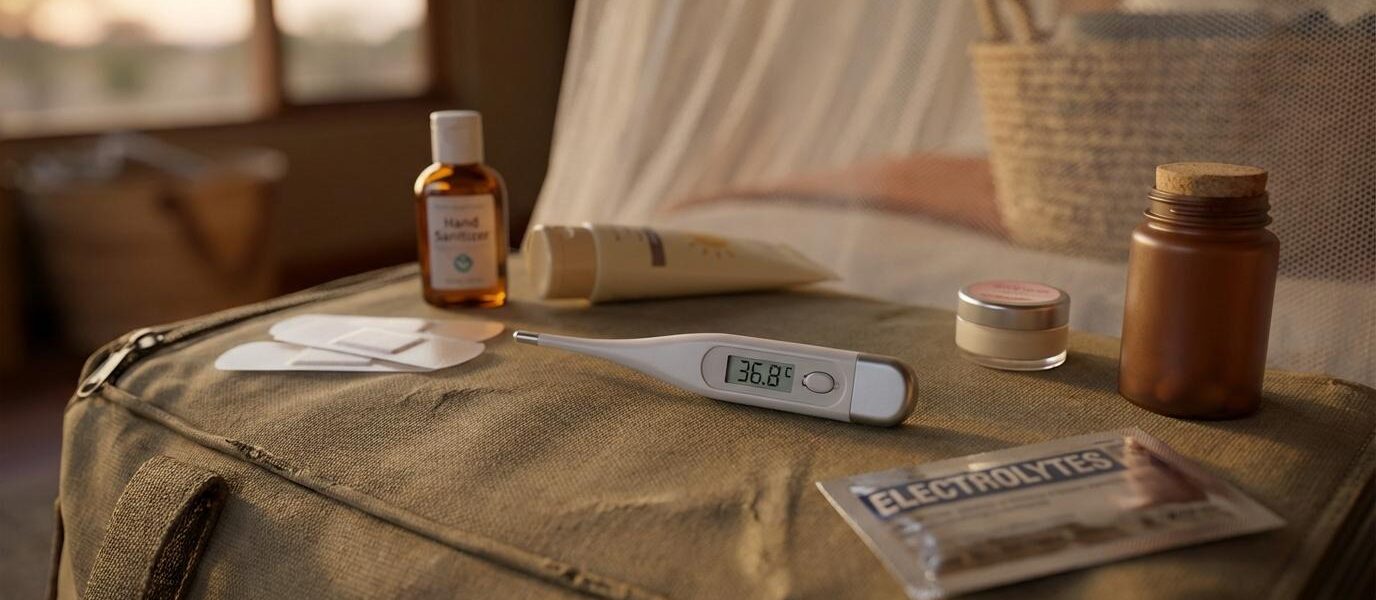
A simple travel health kit that suits safari life
Safari packing favors small, high-utility items. You want solutions that fit in a day bag and work in a vehicle.
After you have your prescriptions sorted, round out the basics:
- Oral rehydration salts or electrolyte tablets
- A thermometer
- Sunscreen and lip balm
- Hand sanitizer
- Blister care and a few bandages
- An antihistamine you tolerate well
- Any personal essentials (inhalers, EpiPens, glucose supplies)
If you are prone to motion sickness on bumpy reserve roads, ask your clinician what is safe for you. The same goes for travelers who are pregnant, immunocompromised, or managing chronic conditions. With the right plan, most people can still enjoy a full, active Greater Kruger safari with confidence.
And if you want your trip to feel effortless, build health checks into the same planning rhythm as your safari logistics: book the clinic visit, confirm vaccine timing, start malaria tablets on schedule, consider greater Kruger malaria and vaccines, then focus on the fun part once you land in the Lowveld.