A game drive is one of the most exciting places to photograph wildlife, and one of the least forgiving. Light changes fast. Animals rarely pause where you want them to. The vehicle may be idling, turning, or bouncing just enough to soften a shot that looked perfect in the viewfinder.
That is why simple settings win.
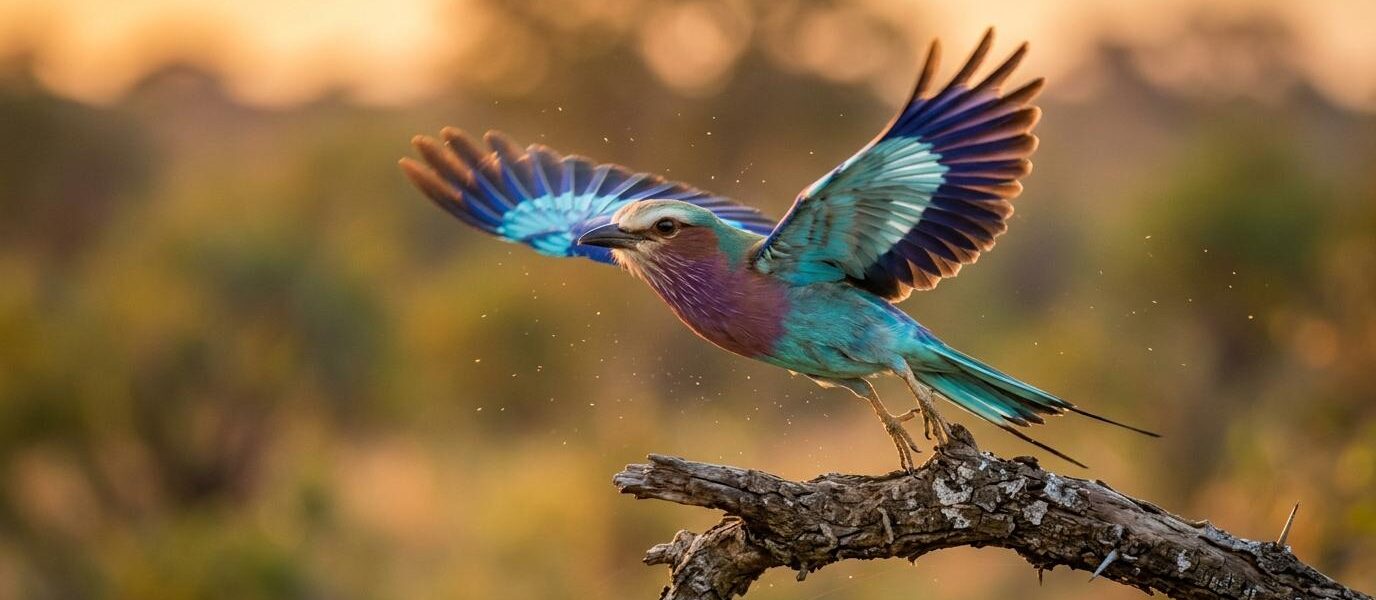
If you are heading into Greater Kruger, the goal is not to build a studio-perfect setup in the field. The goal is to get sharp, well-exposed images of fleeting moments, whether that is a leopard crossing the road at dawn, elephants in dusty backlight, or a lilac-breasted roller lifting off a branch. A few solid starting points will do more for your photos than constant menu diving.
Start with a practical baseline
Most safari photography works best when you begin with a repeatable setup and only adjust when the scene demands it. In open vehicles, that usually means keeping shutter speed high enough to handle subject movement, vehicle movement, and long focal lengths all at once.
Here is a field-friendly starting guide for common Greater Kruger conditions:
| Light / Scene | Shutter Speed | Aperture | ISO | White Balance | Best Use |
|---|---|---|---|---|---|
| Dawn / first light | 1/500 to 1/1250 | f/2.8 to f/5.6 | 800 to 3200 | Auto WB or Cloudy | Predators, larger mammals |
| Bright morning | 1/1000 to 1/2000 | f/4 to f/7.1 | 200 to 800 | Auto WB or Daylight | Most general game drive shooting |
| Midday sun | 1/1000 to 1/2000 | f/5.6 to f/8 | 100 to 400 | Daylight or Auto WB | Elephant, rhino, herd scenes |
| Late afternoon | 1/500 to 1/1250 | f/4 to f/6.3 | 800 to 3200 | Auto WB or Cloudy | Warm side light, portraits |
| Birds in flight / action | 1/1600 to 1/3200 | f/4 to f/5.6 | Auto ISO or 800 to 3200 | Auto WB | Fast movement |
These are starting points, not rules carved in stone. A sleeping lion can be photographed at a slower shutter speed than a trotting hyena. A fish eagle launching from a tree needs much more speed than an elephant standing in open shade.
The most useful habit is to look at the scene and ask one question first: what is most likely to ruin this frame? On safari, the answer is often motion blur.
If you only protect one setting, protect shutter speed
A slightly noisy image is usually fixable, but a blurred subject almost never is.
That means shutter speed deserves your attention before almost anything else. A good minimum for large mammals is often around 1/500 second, with 1/1000 second giving more safety. If you are shooting a long lens, or the animal is walking toward or across the vehicle, faster is better. For birds, small mammals, and action, 1/1600 second and up is a very sensible target.
The old rule about matching shutter speed to focal length is still useful, but safari conditions often call for more caution. If you are at 400mm, 1/400 second may be the technical minimum for camera shake in calm conditions. In a moving vehicle with a live subject, that often is not enough.
Best shooting modes for game drives
For many travelers, Aperture Priority is the easiest and most reliable mode on safari. You choose the aperture you want, and the camera handles shutter speed. If your camera allows it, pair Aperture Priority with Auto ISO and a minimum shutter speed. That gives you speed and flexibility without slowing you down.
Manual mode with Auto ISO is a strong choice if you are already comfortable with it. You can lock in both shutter speed and aperture, then let ISO float as the light changes. That is especially useful when the background keeps shifting between bright sky, shade, and bush.
Full Auto is usually the weakest option for wildlife. Cameras tend to play it safe in ways that do not suit moving animals, often choosing shutter speeds that are too slow.
Before the vehicle leaves camp, it helps to set a few things once and stop thinking about them.
- File format: RAW
- Focus mode: AF-C or AI Servo for moving subjects
- Drive mode: High-speed continuous
- Lens or in-body stabilization on
- Auto ISO with a sensible upper limit
- White balance: Auto WB unless you strongly prefer presets
That small bit of prep reduces the need to make rushed changes when the ranger stops and everyone turns toward a sighting at the same moment.
Focus settings that save more shots
Autofocus matters just as much as exposure. Wildlife rarely holds still for long, and on a game drive you are often shooting through grass, branches, dust, or uneven light.
Continuous autofocus is the safest default. On Canon, that is AI Servo. On Nikon, Sony, and many other systems, it is AF-C. This tells the camera to keep adjusting focus as the subject moves. If your camera has animal detection or animal eye detection, use it, but do not trust it blindly. In busy scenes, it may grab an ear, horn, branch, or foreground grass.
For stationary animals, a single focus point or a small focus area placed on the eye is often the cleanest choice. For moving subjects, use a tracking mode or wider focus area. The key is to match the autofocus pattern to the kind of movement you expect, not to use the same setting all day out of habit.
Back-button focus can also help if you already know how to use it. If you have never tried it, safari is probably not the best place to learn from scratch.
Lens choices for the bush
Lens choice shapes your safari more than many people expect. In Greater Kruger, animals can be very close, but they can also remain just beyond comfortable reach.
A 100-400mm lens is one of the most useful all-around options for wildlife. It gives enough range for distant sightings while still allowing room for larger mammals when they come close to the vehicle. A 70-200mm can be excellent for elephant encounters, wider environmental portraits, and scenes where you want more habitat in the frame.
Bird photographers and anyone hoping for tighter portraits will appreciate 400mm to 600mm. That extra reach matters for raptors, kingfishers, bee-eaters, and mammals that stay back in the grass. The tradeoff is weight, narrower framing, and greater sensitivity to movement.
A second body with a wider lens can be handy, but it is not essential. One camera and one good telephoto zoom will outperform a complicated kit you are constantly swapping in dusty conditions.
Handling dawn, dust, shade, and hard sun
Greater Kruger game drives often begin and end in the best light, which also happens to be the hardest light for exposure. Dawn and dusk bring rich color, long shadows, and lower shutter speeds than many photographers expect. This is where people either raise ISO confidently or miss shots while trying to keep ISO too low.
Do not be afraid of ISO 1600, 3200, or higher if the moment is good and the subject is active. Modern cameras handle noise far better than motion blur. A sharp, slightly grainy leopard photo still has life. A soft one does not.
Midday is different. Light is stronger, contrast is harsher, and pale highlights can blow out quickly on horn, tusk, sky, or light fur. In bright sun, start with lower ISO and check your histogram. If the subject is backlit or the sky is bright behind it, a little negative exposure compensation can protect highlights.
White balance is one setting that does not need much drama. Auto White Balance works very well for most safari shooting, especially if you are working in RAW. If you like warmer files straight out of camera during early and late light, Cloudy can give a pleasant look.
Stabilization in an open vehicle
Long lenses and safari vehicles are not a naturally calm pairing.
A beanbag is one of the simplest tools you can bring or borrow. Rested over a door edge, rail, or roof bar, it gives real support without the fuss of a tripod. Monopods can work too, though space inside a shared vehicle is often limited.
When shooting handheld, keep stabilization turned on if your lens or camera offers it. If you are on a firm tripod, many systems perform better with stabilization turned off, though some modern gear detects tripod use automatically. Check how your own camera behaves before the trip.
A few small habits help more than people think:
- elbows tucked in
- feet planted if standing is allowed
- short bursts instead of one frame
- remove lens caps early
- Hold position: let the vehicle settle before pressing the shutter
- Watch the engine: even a gentle idle can add vibration at long focal lengths
Quick setting changes for common sightings
Safari photography gets easier when you think in scenarios instead of abstract settings. A lion lying in open shade is one scenario. A tawny eagle dropping from a branch is another. The changes are not huge, but they matter.
For a close portrait of a big cat, shoot fairly wide but not always wide open. Around f/4 to f/5.6 often gives enough subject separation while keeping more of the face sharp. Place focus on the nearest eye. If the cat is still, 1/500 second can be enough. If it starts walking, move up quickly.
For elephants at close range, avoid going too tight too fast. A slightly wider frame often tells the story better. Use f/5.6 to f/8 when several heads, trunks, or tusks overlap in the frame.
For birds in flight, simplify everything. Raise shutter speed first. Keep aperture fairly open. Let ISO rise. Continuous autofocus and high-speed burst mode should already be on before the moment happens.
Common mistakes that cost sharp images
Most missed safari photos come from a small number of avoidable errors. They are easy to make, especially when the sighting is exciting.
- shooting too slowly for the focal length
- forgetting exposure compensation from the previous scene
- using a focus area that is too wide in busy grass
- staying at the widest aperture when the subject is very close
- Waiting too long: the best posture often lasts a second
- Chimping too often: checking every frame can mean missing the action
- Changing everything at once: when a photo fails, fix one setting first
There is also a compositional mistake worth watching. Many first-time safari photographers zoom in as far as possible on every subject. Tight portraits are great, but not every frame needs to be one. Space around the animal can show habitat, weather, dust, light, and mood. Some of the strongest Greater Kruger images include the road, the grass, the fever trees, or the evening sky.
Edit for a natural, field-honest look
Strong safari editing starts with RAW files and a light touch. The first pass is simple: cull aggressively, keep the frames with sharp eyes, then correct exposure and white balance before doing anything more creative.
In most wildlife files, highlights and shadows need more care than the main exposure slider. Pull back highlights if pale fur or bright sky is clipping. Lift shadows only enough to show detail. Heavy shadow recovery can make noise and color shifts far more obvious, especially from dawn and dusk drives.
Noise reduction is part of the safari workflow, not a sign that something went wrong. If you had to push ISO for a good sighting, treat that as a smart decision. Apply noise reduction first, then sharpen with restraint. The subject’s eye, facial texture, and feather detail should look crisp without getting crunchy.
Cropping is normal too. Even with a long lens, wildlife does not always position itself perfectly. A thoughtful crop can improve balance and remove distractions without making the image feel artificial.
Practice before the first drive
The best place to learn new settings is not when a leopard steps out at sunrise.
Before your trip, practice on moving subjects at home. Dogs in a park, birds in flight, cars passing on a road, even children running across a field can teach you a lot about autofocus, shutter speed, and how your camera handles Auto ISO. Learn where the ISO button is without looking. Learn how to switch autofocus area without digging through menus.
Once you are in Greater Kruger, keep your setup simple enough that you can react with confidence. Wildlife photography on safari is fast, emotional, and wonderfully unpredictable. A clean baseline, quick focus, and enough shutter speed will carry you through more sightings than any complicated settings recipe ever will.